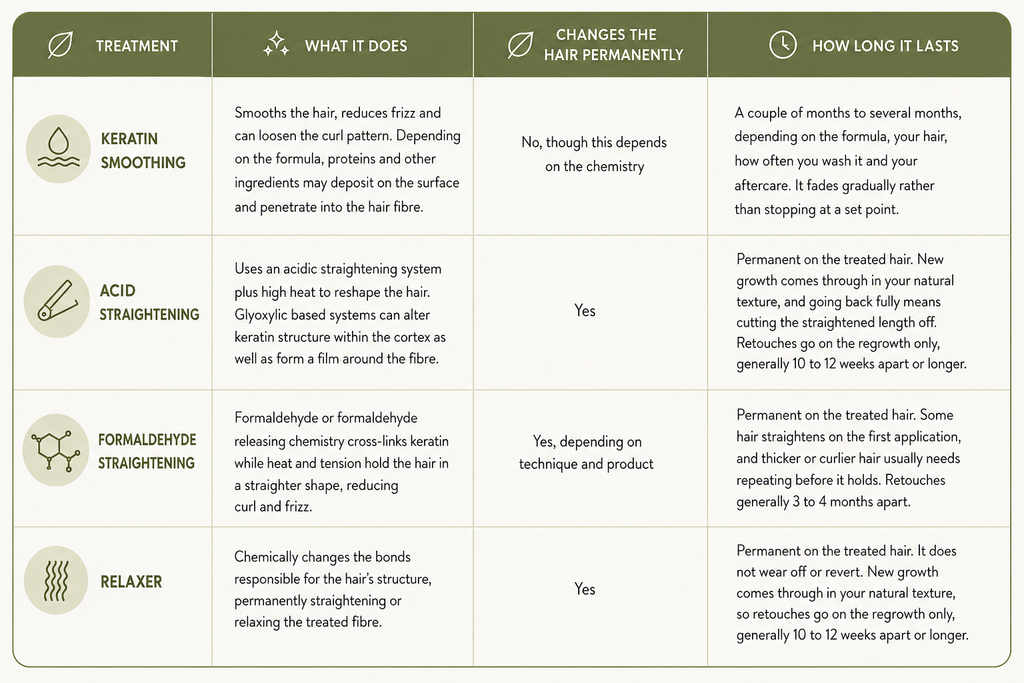
Brazilian hair straightening isn’t one specific treatment; the name is commonly used for different straightening and smoothing treatments, including:
- Keratin smoothing
- Acid straightening
- Formaldehyde straightening
Salons may also offer traditional chemical relaxers when the goal is permanent straightening. That distinction matters because some treatments temporarily smooth hair and reduce frizz, while others permanently straighten it or provide a long-lasting change.
Ask three salons for Brazilian straightening, and you can get three different treatments, even though they have similar names. The question that really matters isn’t what’s named on the price list; it’s:
What chemistry is being used, what will it do to my hair, and is the result temporary, semi-permanent, or permanent?
A part that is rarely explained is that technique matters too. With heat-activated smoothing and acid straightening systems, the product, temperature, tension, and number of flat iron passes work together to determine how straight the final result becomes.
The same bottle in two different hands can give you two different results. Skillful hands matter as much as the product itself.
The product matters. The chemistry matters. And the hands performing the treatment matter.
Here is what actually sits inside the category:
What Is The Difference Between Brazilian Straightening and a Keratin Treatment?
Keratin treatments temporarily smooth hair and reduce frizz, gradually washing out. Straightening treatments chemically alter the hair’s internal bonds, permanently changing the treated hair and creating stronger, longer-lasting results.
Here is why that happens:
1) Keratin
Every hair has an outer protective layer called the cuticle, with the cortex underneath. Your natural curl pattern begins with the shape of the hair follicle beneath the skin and is influenced by how proteins and structural bonds are arranged within the cortex. Over time, heat, colour, UV exposure and everyday wear can damage the cuticle, creating that rough, dull feeling through the lengths – plus making our hair much more prone to frizz the second we step outside in Brisbane.
Keratin smoothing treatment helps create smoother, more uniform hair. Heat helps create the smooth, glossy finish and reduces frizz and volume. The key is that a true temporary smoothing treatment doesn’t permanently convert your natural texture into straight hair. As the treatment gradually wears away, your natural texture becomes more noticeable again.
2) Straightening
Chemical straightening gets past the cuticle and into the cortex, where the bonds that hold your pattern sit; acid straightening opens those bonds so the flat iron can set the hair flat in one go, and formaldehyde straightening does the same thing slowly across a few appointments.
Once those bonds have been reset, that hair has a new shape for as long as it stays on your head.
You will see the difference in how each one leaves; keratin fades so gradually that most women only notice when the frizz returns around month three, and there is no line anywhere marking where it stopped.
Straightened hair keeps its shape while it grows, so a few months in you are looking at your own texture at the roots with flat length hanging off it, and that is the part nobody warns you about at the booking.
Chemical straightening goes beyond temporarily smoothing the hair’s surface. Depending on the chemistry being used, it can alter or reorganise the structure of the hair fibre, while heat, tension and processing help create the straighter result.
This is where knowing the actual treatment and active ingredients matters. Acid straighteners, formaldehyde-based smoothing systems, and traditional relaxers do not all straighten hair through the same chemical mechanism, and you should not treat them as interchangeable.
You can often see the difference in how the result disappears.
A temporary smoothing treatment gradually loses its effect, so you may simply notice your frizz, volume, and curl becoming more visible again over time.
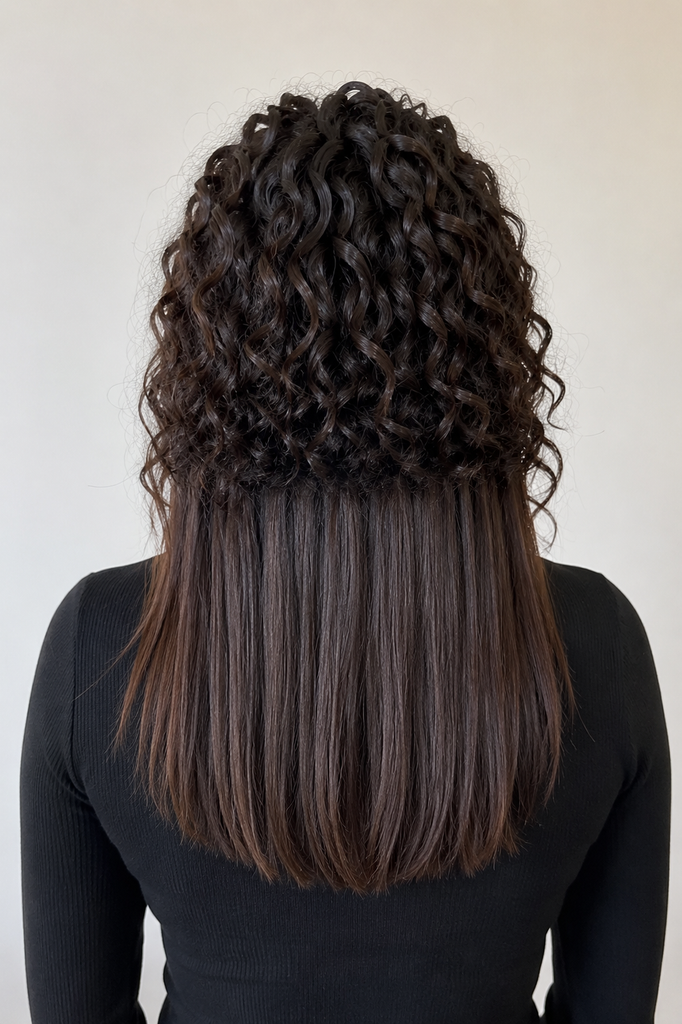
With truly permanent chemical straightening, the treated length remains altered while your new growth comes through in its natural texture. A few months later, you can have your natural curl at the roots with permanently straighter hair through the lengths.
Temporary smoothing fades, but permanent chemical straightening has to grow out.
How Long Does A Brazilian Hair Straightening Last
It depends entirely on which treatment you had, so the right question is:
When is the right time for a retouch?
First, remember this: smoothing treatments fade; chemical straightening grows out (your treated hair stays permanently straight, so you only treat the regrowth).
Smoothing treatments
A smoothing treatment can last anywhere from a couple of months to several months, depending on the formula, your hair, how frequently you wash it and how you look after it.
There isn’t usually a specific moment when the treatment disappears. Instead, you gradually notice more of your natural texture, volume and frizz returning as the smoothing effect wears away.
How often you wash your hair can affect how long the result lasts, and the product used, your previous chemical history, hair condition, and aftercare all play a part.
Straightening has no fade at all; the treated length stays straight until it is cut off, and your natural texture grows in at the scalp underneath, which means the question isn’t how long it lasts but how long you can live with two textures on one head.
Most people go back for the roots roughly every eight to eleven weeks to keep it looking consistent. Every retouch is another chemical service on hair that is already treated, and there is a real limit to how many a head of hair can take before it starts telling you so.
Permanent chemical straightening
With a true permanent straightener or relaxer, the treated hair doesn’t return to its natural texture. It has to grow out and eventually be cut off if you wish to get back to your original hair.
Your natural texture will instead appear at the roots as new hair grows, creating a visible difference between your natural regrowth and the straightened parts.
For traditional chemical relaxers, retouches are generally spaced around 10-12 weeks or longer, depending on hair growth, condition, and the system being used.
The retouch should be applied only to the new growth. Overlapping chemical straightener onto previously treated areas increases the risk of weakening and breakage.
So don’t book your retouch simply because a certain number of weeks have passed between sessions. Pay attention to your regrowth and your hair’s condition, and ask your hairdresser for guidance. Your hair’s chemical history and the straightening product used will determine when (or if) you’re ready for another service.
Is Brazilian Hair Straightening Safe?
It depends on what is actually in the product.
Two ingredients deserve attention: formaldehyde and glyoxylic acid. Australia regulates formaldehyde in cosmetics, and straightening products have previously been recalled here for exceeding permitted levels. Glyoxylic acid presents a different concern: reports of acute kidney injury following hair-straightening treatments have led French health authorities to advise against products containing it while its safety is further assessed.
The frustrating part is that the treatment name alone won’t necessarily tell you which chemistry you’re dealing with. However, once you know those names and know what to ask, the conversation with your stylist becomes much easier.
Formaldehyde:
This is the most well-known, and Australia does regulate it in cosmetics. There is a legal limit on how much free formaldehyde a cosmetic hair product can contain here, and anything above the lower threshold has to carry a “contains formaldehyde” warning on the label.
Australian regulators have previously tested hair-straightening products, recalled major brands that failed the test, required some products to be reformulated to come back into line, and taken action against misleading “formaldehyde-free” claims.
Where things get slippery is the wording…
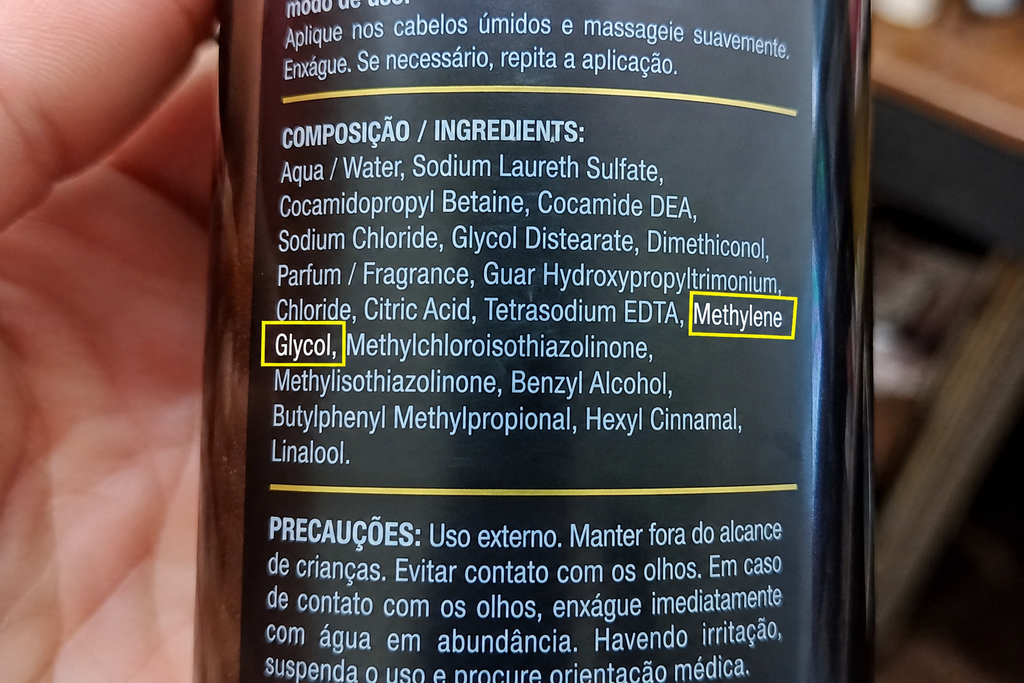
Formaldehyde often is associated with methylene glycol, and the vapour released once the product is heated increases the exposure to formaldehyde – which is the exact moment the flat iron touches your hair – to both stylist and client.
Australian regulators have also previously found products marketed as formaldehyde-free to contain formaldehyde. So “formaldehyde free“ on the front label does not guarantee its claim, and it is fair to ask your stylist what the actual active ingredient is.
Glyoxylic acid:
When formaldehyde was restricted, many brands started using glyoxylic acid as an alternative. However, being formaldehyde-free doesn’t automatically mean risk-free.
Australia’s chemicals regulator, AICIS, assessed glyoxylic acid in 2022. It noted that the ingredient is used internationally in semi-permanent hair straightening products, often in highly acidic formulations because a low pH can make the straightening process more effective.
More recently, concerns have emerged overseas about a very different potential risk.
In France, health authorities received reports of women developing acute kidney injury within hours of Brazilian straightening treatments containing glyoxylic acid. After reviewing the cases and wider scientific evidence, French health agency ANSES concluded that glyoxylic acid very likely played a causal role.
ANSES currently advises consumers and hair professionals not to use hair-straightening products containing glyoxylic acid and has called for a European-level safety assessment to determine whether its use in hair products should be restricted or even banned.
And the French cases aren’t the only ones. Medical literature reviewed by ANSES includes additional reports of acute kidney injury following hair straightening, including a series of 26 cases in Israel. Researchers believe glyoxylic acid absorbed into the body can be converted into oxalate, which can form calcium oxalate crystals in the kidneys and potentially cause serious injury.
That doesn’t mean every straightening treatment will cause harm. It means the actual chemistry matters more than the marketing name on the bottle.
Three questions, and you are allowed to ask all of them:
- What is the active ingredient in this product?
- Does it carry a formaldehyde warning on the label?
- What ventilation and exposure measures are taken during the service?
Any salon worth your money will answer those without getting funny about it, and how they answer tells you nearly as much as the answer itself.
Where we stand: we don’t do chemical hair straightening at Babalu, and we wouldn’t put anything on your hair that a health authority has restricted or asked people to avoid. If something has been pulled off shelves somewhere, or a regulator has said to wait, that is enough for us to leave it alone until the picture is clearer.
One final thing to hold onto from all of the above: if you become unwell after a straightening treatment, seek medical attention. It is always safer to get help early and let your healthcare provider know that you recently had a chemical hair treatment, particularly if your symptoms are persistent or getting worse.
What Are The Downsides Of Brazilian Hair Straightening?
Keratin smoothing requires ongoing upkeep, and as the treatment wears off, it can feel like your hair has gotten worse when it has mostly returned to its natural texture. Repeating treatments too often can expose the hair to cumulative heat and chemical damage.
Permanent chemical straightening comes with its risks. It can weaken the hair fibre, make it more prone to breakage and dryness, while some formulas can irritate or chemically burn the scalp if incorrectly applied.
Neither is a reason to panic, and both are worth understanding before you book.
Here is what actually happens with each:
Keratin smoothing
It works more like surface patching than deep repair. It can make the surface feel smoother, reduce frizz, and add incredible shine, but it may not repair split ends, dryness, or structural damage underneath.
As the coating gradually wears off, your natural texture becomes visible again. It can feel like the treatment has wrecked your hair when in reality it was just the smoothing effect disguising those characteristics.
Damage results from treatments done too frequently. Chemical exposure and high heat will stack up on and progressively compromise the hair fibre. That’s when you’ll start seeing dry, dull, and brittle hair, showing up as split ends, limp strands, and more shedding than usual.
Maintaining the result may also mean changing your haircare routine, including (or excluding) products, more at-home treatments (eg: moisture and/or nutrition masks), not sleeping with hair wet, washing it less, and whatever your hairdresser recommends.
Permanent Chemical straightening
The effects here are better documented and harder to undo.
Traditional chemical relaxers permanently alter bonds within the hair fibre. That chemical process can reduce the hair’s strength and make the treated lengths more prone to breakage, especially when the hair is repeatedly processed or combined with other chemical services.
Research on Consumer Notice about chemical hair straighteners reported that scalp inflammation, damage to the hair shaft, breakage, damage, and hair loss are common symptoms, as well as dryness, weakening, and colour changes. If applied incorrectly, the same products can cause irritation and chemical burns to the scalp and hairline.
That doesn’t mean everyone who straightens their hair will experience these problems. It means that everyone who decides to go down this path will need to treat their hair- both during the service and afterward.
Why Brazilian Hair Straightening At Home Is Riskier Than It Looks
Home kits are riskier because you lose three things a salon provides: an assessment of your hair before anything goes on it, controlled heat, and proper ventilation.
You are handling the same chemistry in a bathroom, with the door shut. A salon offering these treatments should have a ventilation system installed, use lower heat settings on dryers, monitor formaldehyde levels with a sampling kit, train staff annually to handle the chemicals, and provide gloves, aprons, eyewash stations, and masks.
Your bathroom has a fan, if you are lucky. The chemicals in at-home kits can release formaldehyde gas the same way salon products do, so ventilation matters just as much when you are doing it yourself.
Then there is the label Formaldehyde problem: it hides in ingredient lists as formalin, methylene glycol, or methanediol, so a product can be sold as formaldehyde-free while containing something that turns into it under heat.
Heat is the third thing: a home kit still needs a flat iron sealing every section, and how you use that flat iron determines both the result and how much damage you do.
You can’t do a second attempt. If the hair is bleached, coloured, relaxed and/or already breaking, a strand test tells you how it will respond before the whole head is committed. Almost nobody who is doing this at home bothers to do one.
However, if you do it anyway, three things are worth controlling.
1) Read the ingredient list for the words above rather than trusting the front of the box.
2) Open a window and the door, and do not do it in a small closed room.
3) Follow the proper pause between treatments, because doing it too often is where the breakage comes from.
Before you book anything:
The takeaway is that your hair is only ever doing one of two things after any of these treatments. It’s either wearing something that will wash off, or it’s been changed and is now growing out.
Everything else- the brand names, the before and afters, the promises about shine- sits on top of that one question.
Also, there is a piece of this that rarely gets said out loud; every treatment in this category was built to make textured hair behave like hair it is not, and the industry has spent decades selling that as the only route to hair that is easy to live with.
It is not the only route; plenty of women choose straightening their hair because managing their own texture became exhausting (or they don’t know how), not because they wanted something different.
If you came here because your hair has become hard to live with, the more useful question is whether the problem is your texture or that nobody has ever worked with your texture properly.
A reminder: We do not offer straightening at Babalu (only smoothing, since it’s not permanent), and we have no plans to. What we do is add length and density that keeps the pattern you already have, so daily management gets easier without resetting anything.
Frequently Asked Questions about Brazilian Hair Straightening (FAQ)
1. What is the healthiest hair straightening treatment?
The gentlest option in this category is a smoothing treatment, because it coats the hair and washes out instead of breaking the bonds inside it. That still depends on what is in the bottle, since some smoothing formulas contain formaldehyde or glyoxylic acid. Nothing here repairs damaged hair, so if your hair is already breaking, none of these is the healthy choice.
2. What do Brazilian hair straightening before and after results actually look like?
That depends on your natural texture and how the flat iron was used, which is why two people can get different results from the same treatment. Wavy hair usually goes straight; curly/coily hair often comes out looser and less frizzy rather than flat; and tighter textures need a permanent treatment to get anywhere near the photos. Most before-and-afters online are shot on hair that was already close to the result.
3. Is Brazilian hair straightening safe for curly hair?
A smoothing treatment can work on curly hair, and it will loosen your pattern while it lasts, so expect looser curls rather than the same curls with less frizz. Permanent options carry more risk for curly and coily hair, since dermatology research links them to weakened hair shafts, breakage, and scalp irritation. Curly hair also tends to need more heat to hold a straight result, which is where a lot of the damage comes from.
4. Can you get Brazilian hair straightening with extensions in?
Yes, as long as the hairdresser applies the product only to the areas without extensions. It works better if the client wears weft extensions.
For other semi-permanent types like tape-ins and k-tips, we highly recommend removing them first. The product and the flat iron cannot reach the hair underneath properly without going near the attachment points, and the natural hair under an install is already carrying weight and tension. If you are wearing extensions and want smoother hair, ask your stylist who installed them before you book this service.